Su Bingtian ran the fastest times at 6.29 in 60m and 3.73 in 30m during his 9.83 race

>> September 18, 2021

At the Tokyo 2020 Olympics, Su Bingtian clocked a time of 9.83 (+0.9) to win his men's 100m semifinals. 

He achieved the time with a "standard" reaction time of 0.142.

This time is phenomenal. The closest mark by a non-black sprinter was 9.92, which was set by Bingtian himself. The next fastest among a non-black decent is Frenchman Christophe Lemaitre with a 9.92 clocking. 

The split times are fascinating. En-route to his 9.83 clocking, Bingtian set a time of 6.29 at 60m, as well as recorded 3.73 at 30m; both are now being confirmed as the fastest times by a human being for these distances. 

It means that the 5'7" tall Chinese was running faster than Usain Bolt at some points of the 100m dash.

For a comparison, Usain Bolt recorded 3.78 and 6.31 for the 30m and 60m, respectively when he set the 9.58 world record in 2009.

He broke the sub-10 for the first time in 2015 at the Prefontaine Classic in Eugene, Oregon. In the same year, he ran the time once again during the world championships in Beijing. 

Three years later in 2018 he lowered his best time to 9.91 in Madrid that equaled Femi Ogunode's Asian record. He repeated the feat a week later in Paris. At the same year, he won the Asian Games in Jakarta in 9.92.

Earlier of his sprint career, he set the Chinese national record for the 100m in 2011 National championships, setting 10.16, that was 0.01 faster than the old mark of 10.17 jointly held by Zhou Wei (1998) and Chen Haijian (2003).
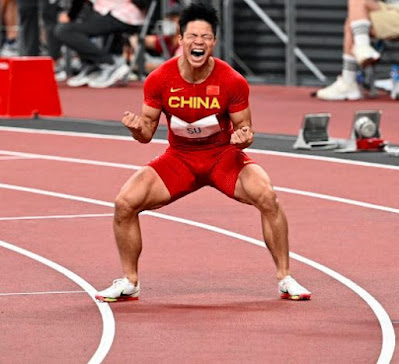
Su Bingtian recorded 9.83 (100m); 3.73 (30m), 6.39 (200m)

Su Bingtian's progression in the 100m since 2006 (from age 17):
2006- 10.59
2007- 10.45
2008- 10.41 (best time as a junior sprinter)
2009- 10.32
2010- 10.32
2011- 10.16
2012- 10.19
2013- 10.06
2014- 10.10
2015- 9.99
2016- 10.08
2017- 10.03
2018- 9.91 (=Asian record)
2019- 10.05
2020- na
2021- 9.83 (Asian record)

Read more...

Detrimental effects of COVID-19 lockdown on sports and athletes

>> September 11, 2021

The lockdowns imposed due to the COVID-19 pandemic have had multifaceted effects on athletes, impacting their physical fitness, training routines, mental well-being, and career opportunities, among other aspects of their professional and personal lives. 


Recently, a global study investigated training-related knowledge, beliefs, and practices of 12,526 athletes from 142 countries and six continents during the COVID-19 lockdown (Washif et al., 2021). 

Based on this study, most athletes wanted to maintain training and disagreed with the idea of not training during lockdown. However, they had moderate knowledge and beliefs about training disruptions, de-training, and their effects. 

Furthermore, the study reported that during lockdown, athletes trained alone and focused on general fitness and health maintenance. Specific training, such as endurance and interval training, was challenging to maintain at pre-lockdown levels. 

The authors also noted that training frequency, duration, and intensity were reduced for most athletes. 

The study provides insights for policy makers, athletes, and their teams regarding lockdown challenges, and ideas to adapt training practices during similar disruptions. 

More insights regarding the general impact of lockdown on athletes from the study and other resources, are provided below.

Physical, physiological, and performance effects 

Decreased fitness levels as a result of lack of regular and intensive training, affecting cardiovascular fitness, muscle strength, and endurance, etc. 

Weight gain or loss. Changes in dietary habits (in negative ways), combined with decreased physical activity, have negative impacts on athletes' body composition. 

Reduced skill proficiency due to missing regular practice that diminishes skill levels in certain sports (particularly those that requires sophisticated equipment). 

Increased injury risks from a sudden resumption of intense training post-lockdown. 

Mental and emotional effects 

Mental health concerns may be triggered due to increased feelings of anxiety, depression, and stress, resulted from uncertainty about the future and disruptions in routine. 

Lack of motivation, as a result of the absence of competitions, as well as structured training and regular interaction with teammates. 

Concerns about returning to pre-lockdown performance levels may also induce stress. Changes in routine and environment (home training; limited resources) can lead to distractions and decreased concentration. 

Athlete's career and future 

Lost opportunities, e.g., sponsorship deals. Missing key events may impact athlete ability to look for, or be scouted or gain sponsorships. 

Extended lockdowns or multiple lockdowns can potentially shorten the career span of athletes, especially in sports with "limited active years."

Nevertheless, it's worth noting that lockdown effects can vary depending on the athlete's sport, level of professionalism, geographical location, among others. 

For example, the Washif et al. (2021) study outlined that higher level athletes (e.g., world class, international-level) had better access to resources and were more receptive to remote coaching. 

"Higher level athletes had a stronger desire to maintain training, retained training specificity to a greater degree, had better access to resources, and were more receptive to remote coaching compared to lower level athletes during the COVID-19 lockdown" (Washif et al., 2021). 

Lockdowns significantly altered athletes' lives and routines, impacting physical health, mental well-being, and career trajectories, highlighting the need for specific assistance, as well as adaptability and resilience in unprecedented times.

Reference
Washif JA, Farooq A, Krug I, Pyne DB, Verhagen E, Taylor L, et al. Training during the COVID-19 lockdown: knowledge, beliefs, and practices of 12,526 athletes from 142 countries and six continents. Sports Medicine. 2021; 1-16. https://link.springer.com/article/10.1007/s40279-021-01573-z 

Read more...

Ziyad Zolkefli threw 17.94m shot put at Tokyo Paralympics

>> August 31, 2021

Malaysia's Muhammad Ziyad Zolkefli threw 17.94m in men's shot put (F20) of the Tokyo 2020 Paralympics today (31 Aug).


The 31-year-old surpassed his own world record of 17.29m he set in 2017 world Paralympic championships.  

He opened with a distance exceeding his world record by 2cm (17.31m) before registering 16.87m, and then his best distance in the third throw.
Ziyad Zolkefli has thrown 17.94m in men's shot put

His fourth throw gave him a distance of 17.62m, but the rain started shortly, right before the final two throws, and seen affecting all the competitors; Ziyad's last two throws were 16.31m and 16.39m, respectively.

Ziyad's best throwing distance also exceeded the Malaysian able-bodied national record of 17.53m set by Adi Alifuddin en-route to win silver at 2011 SEA Games.

Very unfortunate that he was competing "under protest" and declared as DNS (did not start), along with two other athletes Jordi Congo (Ecuador) and Todd Hodgetts (Australia).

The Gold medal went to Ukrainian Maksym Koval who threw 17.34m, and officially breaking Ziyad's world record.

Ziyad won gold medal during the last Paralympic edition in Rio, throwing a distance of 16.84m, which was a new games record.

Men's shot put (F20) Tokyo Paralympics - official result

Read more...

The Case for Invalidating 10.49 World Record: Thompson-Herah 10.54 in 100m Should Be a New World Record

>> August 22, 2021

1. This morning, 22 August 2021 (or 21 August in Eugene, Oregon, US.), ELAINE THOMPSON-HERAH of Jamaica has posted the all-time 2nd fastest time in the 100m, she clocked a time of 10.54 (+0.9), which could have been a NEW WORLD RECORD (WR).

2. Florence Griffith-Joyner's 10.49 WR set during the 1988 U.S Olympic Trials in Indianapolis, has been the most suspicious record in athletics; Flo-Jo's best time before that season was 10.96, half of a second slower.
Elaine Thompson-Herah clocked 10.54 in 100m

3. Since 1997, the Association of Track and Field Statisticians (ATFS) flagged the 10.49 as "probably wind-assisted".

4. I could talk about "quit athletics shortly, introduction of out of competition drug testing, and early death (10 years later)" - but we keep it ‘shorter’ (save for another story and no speculation).

ATFS Annual in 1997 started questioning the validity of 10.49 

5. What is the main issue with the 10.49 ‘WR’ - simply about the accuracy of wind reading; the anemometer (wind instrument) was most probably malfunction during Flo-Jo's (quarterfinal 1) race (and the next one), and produced zero or "0.0 m/s wind".

6. The maximum limit of tailwinds is 2.0 m/s (this value itself, would give a benefit of ~0.12 secs faster time).

7. The quarterfinals of the 1988 U.S Olympic Trials: Flo-Jo was in heat 1 (wind: 0.0 m/s) setting 10.49. In heat 2 (0.0 m/s), Shield Echols set 10.83 (i.e., her lifetime 'PB'). In heat 3, the anemometer was "ok/fixed?" and recorded 5.0 m/s winds, won by Gwen Torrence in 10.78w. 

8. During the same day, the same anemometer recorded wind-assisted for all the Round 1 heats (>2.7 m/s).

9. The wind-reading of 0.0 m/s in quarterfinals 1 and 2 was not accurately represent the possible racing conditions. 

10. The wind-reading was not consistent with the timings the athletes achieved. The meeting officials raised their concerns about the wind readings. Also, an extremely high number of seasonal and personal bests was recorded during quarterfinals 1 and 2. Other argument included flag flapping wildly, suggesting strong winds. 
Flo-Jo recorded 10.49 in 1988 U.S. Trials (and 10.61 in Olympics)

11. The estimated wind-reading for Flo-Jo’s ‘WR’ heat 1 race was greater than 5.0 m/s (and the heat 2 was >3.0 m/s).

12. Six athletes who recorded massive improvements during the quarterfinal 1 (Flo-Jo’s heat), have recorded ~0.28 secs slower during their semi-final races, even though the races were ‘assisted’ by tailwinds greater than >1.3 m/s. Logically, each of them would set an even faster time, including Flo-Jo, i.e., ~10.42.

13. At the same time above (quarterfinals), the men's triple jump was held;  just next to the track, same direction; here, Willie Banks registered 18.20m, exceeded WR, but wind-assisted: 5.2 m/s. In fact, all of his jumps were wind-assisted (>3.4 m/s).

14. The available 'evidences' above provided enough suspicion to the ‘current WR of 10.49’ by Flo-Jo (i.e., one of my all-time favorites). 

15. Flo-Jo’s 10.49 should not have been ratified in the first place. Her 10.61 time, recorded during the finals of the U.S. Olympic Trials should be women's world record.

16. Flo-Jo’s 10.61 ‘WR’ was equaled by Thompson-Herah during Tokyo 2020 Olympics, and ‘broken’ this morning with 10.54 (+0.9).
All-Time lists for women's 100m (as of 22-8-2021)

17. Note that in Tokyo, the 100m race was into a headwind of -0.6 (i.e., -0.03 disadvantage). In Eugene Diamond League, a +0.9 wind favored the 100m race (i.e., +0.06 advantage). 

18. Possibilities: At 0.0 m/s wind, Thompson-Herah would have run 10.58 in Tokyo, and 10.60 in Eugene. At 2.0 m/s winds, Thompson-Herah would run 10.46 in Tokyo, and 10.48 in Eugene.   

19. With recent technologies (including running track), available training window (i.e., 2021-2024), competitiveness, world-record aim, etc. I think, we are going to witness a sub-10.49 time in women’s 100m race, legally.

Read more...

Malaysian female candidates in athletics for the 2020 Tokyo Olympics

>> June 24, 2021

A female athlete maybe selected to represent Malaysia at the Olympics. In the previous two editions, Malaysia was represented by Zaidatul Husniah Zulkifli (2016) and Noraseela Mohd Khalid (2012). No Malaysian female athletes have qualified for this year's Olympics. Thus, the following may apply:

a. NOCs (country) with no male or female qualified athlete or relay team will be allowed to enter their best ranked male athlete or their best ranked female athlete in one athletic event, with the exception of the Combined Events, 10,000m and 3000m Steeplechase.

b. This applies equally to unqualified female entries from an NOC with qualified males, and vice versa

Using my specific's year database and compilation including info from my fellow ATFS colleague Heinrich Hubbeling (Asian Athletics Association), Tilastopaja.org, and World Athletics, here is a list of Malaysia's possible candidates for the 2020 Olympics. 
 
These information considers current performance of the athletes during the period of 2019 to present (i.e. season best). 

Husniah (100m), Kirthana (triple jump), Yap Sean Yee (high jump) and Grace (hammer)

Final decision by Malaysian Athletics Federation:  

......................................................................


Azreen Nabila Alias (100m)
  • Age: 21
  • 2021 SEA Top List: 6th (4th for SEA Games)
  • 2019 SEA Games: N/A
  • World Athletics Ranking:  1405th / 989 points
  • Season Best & Result Score:  11.92 (1007 points)
  • National Record Holder: No
  • Personal Best: 11.81s, Ipoh, 2018
  • All-Time Best Performances: 
          o Asian Youth – 6th (2017)
  • Progress at 100m: 2015- 12.17, 2016- 12.02, 2017- 12.26, 2018- 11.81, 2019- 11.92, 2021- 12.00.

Grace Wong Xiu Mei (Hammer Throw)
  • Age: 21
  • 2021 SEA Top List: 1st 
  • 2019 SEA Games: silver medal
  • World Athletics Ranking: 274th / 916 points 
  • Season Best (Result Score): 62.48m (972 points)
  • National Record Holder: YES (62.48m)
  • All-Time Best Performances: 
          o Asian Championships: 5th (2015) 
          o SEA Games – Gold (2017)
  • Progress at hammer throw: 2015- 53.80, 2016- 57.76, 2017- 60.99, 2018- 56.51, 2019- 55.82, 2020- 62.61 (trials), 2021- 62.48.

Kirthana Ramasamy (Triple Jump)
  • Age: 24
  • 2021 SEA Top List: 3rd 
  • 2019 SEA Games: 4th 
  • 2019 ASIAN Championships: 5th 
  • World Athletics Ranking: 135th / 1057 points 
  • Season Best (Result Score):  13.33m (1049 points) 
  • National Record Holder: No
  • All-Time Best Performances (Pre-2019): 
          o SEA Games – 4th (2017)
          o Asian Juniors – Gold medal (2016)
          o World Juniors – Qualifying round (2016) 
  • Progress at triple jump: 2015- 13.13, 2016- 13.31, 2017- 13.48, 2018- 12.95, 2019- 13.35*, 2020- 13.06, 2021- 13.21.


Siti Fatimah Mohamad (100m)
  • Age: 34
  • 2021 SEA Top List: 9th (6th for SEA Games)
  • 2019 SEA Games: N/A
  • World Athletics Ranking: 1138th / 1005 points 
  • Season Best & Result Score:  11.93 (1020 points)
  • National Record Holder: No
  • Personal Best: 11.77s, Kuala Lumpur, 2008
  • All-Time Best Performances: 
          o Asian Championships – 6th (2017) 
          o SEA Games – 5th (2017)
  • Progress at 100m: 2015- 12.09, 2016- 11.87, 2017- 11.80, 2018- 12.04, 2019- 11.91, 2021- 12.12.

Yap Sean Yee (High Jump)
  • Age: 26
  • 2021 SEA Top List: 1st 
  • 2019 SEA Games: Gold medal
  • World Athletics Ranking: 209th / 1029 points 
  • Season Best (Result Score):  1.81m (1023 points)
  • National Record Holder: YES (1.83m, 2017)
  • All-Time Best Performances: 
          o Asian Championships - 5th (2015)
          o Commonwealth Games 2014 – Qualifying round
          o SEA Games – bronze (2017)
  • Progress at high jump: 2014- 1.75m, 2015- 1.77m, 2016- 1.79m, 2017- 1.83m, 2018- 1.78m, 2019- 1.81m, 2020- 1.76m, 2021- 1.80m.


Zaidatul Husniah Zulkifli (100m)
  • Age: 27
  • 2021 SEA Top List: N/A
  • 2019 SEA Games: N/A
  • World Athletics Ranking:  806th / 1031 points 
  • Season Best (Result Score):  11.68s (1056 points)
  • National Record Holder: No
  • Personal Best: 11.59s, Weinheim, 2018
  • All-Time Best Performances: 
          o Rio Olympics – heats 
          o Asian Games 2018 – 8th 
          o Commonwealth Games 2018 – semi-final
          o World University Games – semi-final
          o SEA Games – silver (2017)
  • Progress at 100m: 2013- 11.87, 2014- 11.62, 2015- 11.69, 2016- 11.67, 2017- 11.61, 2018- 11.59, 2019- 11.65.
*insufficient into (e.g. wind reading)

The lists will be updated if necessary

Read more...

ASIAN LEADERS (Men)

To be updated

STATISTICS

STATISTICS

ASIAN LEADERS (Women)

To be updated

Statistics


ARCHIVES

Copyright © 2009-2018, AdrianSprints.com . All Rights Reserved . Policy . Term of Use
Sports Top Blogs Sports blogs & blog posts Free Web Stats

Back to TOP