Azeem Fahmi clocks world-class time of 10.09 (+0.8) at Cali, Colombia

>> August 02, 2022

Azeem Fahmi has set a new Malaysian national record in the men's 100m. 

The 18-year-old clocked a world-class time of 10.09 (+0.8 m/s) to win the heat 8 in the first round of the World Athletics U20 Championships, today, August 1st (August 2nd in KL) in Cali, Colombia. 


He took 44.5 steps (a world-class standard) to break Khairul Hafiz Jantan's national record of 10.18, set during the SUKMA (Malaysian Games) in July 2016.

He was the second fastest in the round 1, behind the world U20 record holder Letsile Tebogo of Botswana, who set a new championship record of 10.00 (-0.6). 


Azeem improved his best time of 10.28 from the Ipoh All-Comers in June. In early March, he bettered his pre-2022 best of 10.57 with 10.53 during the Malaysia open championships. He lowered his time again (10.37) during KL All Comers, two weeks later.

Currently, Azeem is ranked first among the U20 sprinters in Asia, and is tied for 4th on the senior ranking list, behind Sri Lanka's Yupun Abeykoon (9.96), Japan's Abdul Hakim Sani Brown (9.98), Japan's Ryuichiro Sakai (10.02), and South Korea's Kim Kukyoung (10.09).

National Record progress and evolution (official + non-official + rejected)

By Jad Adrian ATFS statistician

10.09 Muhammad Azeem Fahmi 2022 (pending)
10.18 Khairul Hafiz Jantan 2016
...(10.29 Badrul Hisyam 2015, not ratified)
...(10.20w Watson Nyambek 1998, wind-aided)
...(10.25w Watson Nyambek 1998, wind-aided)
10.30 Watson Nyambek 1998
10.31 Watson Nyambek 1998
...(10.0h Watson Nyambek, manual-timing, 1998)
10.33 Watson Nyambek 1996
10.38 Azmi Ibrahim 1995
10.38 Watson Nyambek 1995
10.42 Watson Nyambek 1995
10.45 Watson Nyambek 1995
10.46 Watson Nyambek 1995
10.48 Azmi Ibrahim 1994
...(10.38w Jegathesan Manikavasagam 1968, wind-aided)
10.49A Jegathesan Manikavasagam 1966
10.60 Jegathesan Manikavasagam 1964
_ Jad Adrian_

As of 2 August 2022, 12.00pm


Video of Azeem Fahmi, setting the Malaysian national record in 10.09s (+0.8 ) to win his heat 8 race (round 1) of the World Athletics U20 World championship in Cali, Colombia.


Read more...

Queenie Ting became the first Malaysian to throw over 50m in women's discus throw

>> November 14, 2021

A new national record was set during the Malaysian Track & Field Trials on Sunday (14 November). 

Queenie Ting Kung Ni has thrown 50.67m to break her own national record of 48.56m she set during the Malaysian Grand Prix in April this year.

It was an improvement of more than two metres.


The 24-year-old achieved it twice, first with 49.02m from the second throw, before throwing the >50m mark in the 3rd throw.

She became the first Malaysian to throw over 50m for women's discus throw.

SELECTED RESULTS:

MEN

100m (13)
Race A
1. Mohammad Raimi Mustaffa Kamal 10.5h

Race B 
1. Jonathan Nyepa 10.4h
2. Muhammad Zulfiqar Ismail 10.5h
3. Luqmanul Hakim Khairul Akmal 10.6h

200m (14)
1. Luqmanul Hakim Khairul Akmal 21.6h
2. Muhammad Ilham Suhaimi 21.8h
3. Mohammad Raimi Mustaffa Kamal 21.9h
4. Muhammad Zulfiqar Ismail 22.0h

400m (13)
1. Muhammad Ilham Suhaimi 48.4h
2. Ruslem Zikry Putra Roseli 48.7h
3. Muhammad Saiful Safwan Saifuddin 48.8h

1500m (13)
1. Muhammad Amirul Arif 4:01.1h
1. Ahmad Luth Hamizan 4:03.8h

3000m Sc (13)
1. Ahmad Luth Hamizan 9:51.9h

400mh (14)
1. Ruslem Zikry Putra Roseli 52.9

High Jump (14)
1. Lee Hup Wei 2.10

Pole Vault (13)
1. Iskandar Alwi 5.00

Long Jump (14)
1. Andre Anura 7.10

Triple Jump (13)
1. Brendon Ting Li King 15.08
2. Muhammad Nazri Mustafa 14.76

Shot Put (13)
1. Farm Loong Deng 15.75
2. Kong Chin Poh 15.38
3. Jonah Chang Rigan 14.93

Discus Throw (13)
1. Kamal Farhan A. Rahman 47.22
2. Jonah Chang Rigan 43.32
3. Faris Hazim Jamaludin 42.60


WOMEN

100m (13)
1. Fatin Ilyana Mat Nayan 12.1h
2. Nur Sarah Aadi 12.2h
3. Siti Zubaidah Adabi 12.4h

200m (14)
1. Komalam Shally Selveratnam 25.2h
2. Nurul Asma Faizah Mazlan 25.3h

400m (13)
1. Nurul Asma Faizah Mazlan 57.5h

800m (14)
1. Savinder Kaur 4:14.4h


High Jump (13)
1. Norliyana Kamaruddin 1.70
2. Ngu Jia Xin 1.70
3. Yap Sean Yee 1.70

Long Jump (13)
1. Nur Asyikin Abas 5.78
2. Kirthana Ramsamy 5.65
3. Nur Sahar Adi 5.62

Discus Throw (14)
1. Queenie Ting Kung Ni 50.67 (NR)
2. Connie Choo Kang Ni 45.25
3. Yap Jen Tzan 40.60

Javelin Throw (13)
1. Nur Ayna Nuha Maton 38.86
2. Pavithra Devi Jayaindran 38.28

Read more...

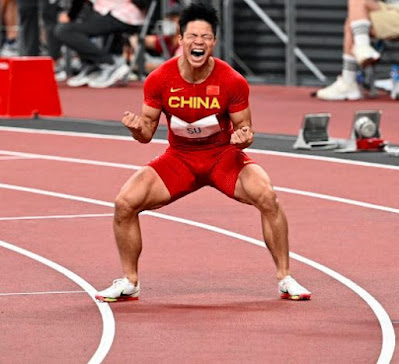
Su Bingtian ran the fastest times at 6.29 in 60m and 3.73 in 30m during his 9.83 race

>> September 18, 2021

At the Tokyo 2020 Olympics, Su Bingtian clocked a time of 9.83 (+0.9) to win his men's 100m semifinals. 

He achieved the time with a "standard" reaction time of 0.142.

This time is phenomenal. The closest mark by a non-black sprinter was 9.92, which was set by Bingtian himself. The next fastest among a non-black decent is Frenchman Christophe Lemaitre with a 9.92 clocking. 

The split times are fascinating. En-route to his 9.83 clocking, Bingtian set a time of 6.29 at 60m, as well as recorded 3.73 at 30m; both are now being confirmed as the fastest times by a human being for these distances. 

It means that the 5'7" tall Chinese was running faster than Usain Bolt at some points of the 100m dash.

For a comparison, Usain Bolt recorded 3.78 and 6.31 for the 30m and 60m, respectively when he set the 9.58 world record in 2009.

He broke the sub-10 for the first time in 2015 at the Prefontaine Classic in Eugene, Oregon. In the same year, he ran the time once again during the world championships in Beijing. 

Three years later in 2018 he lowered his best time to 9.91 in Madrid that equaled Femi Ogunode's Asian record. He repeated the feat a week later in Paris. At the same year, he won the Asian Games in Jakarta in 9.92.

Earlier of his sprint career, he set the Chinese national record for the 100m in 2011 National championships, setting 10.16, that was 0.01 faster than the old mark of 10.17 jointly held by Zhou Wei (1998) and Chen Haijian (2003).

Su Bingtian recorded 9.83 (100m); 3.73 (30m), 6.39 (200m)

Su Bingtian's progression in the 100m since 2006 (from age 17):
2006- 10.59
2007- 10.45
2008- 10.41 (best time as a junior sprinter)
2009- 10.32
2010- 10.32
2011- 10.16
2012- 10.19
2013- 10.06
2014- 10.10
2015- 9.99
2016- 10.08
2017- 10.03
2018- 9.91 (=Asian record)
2019- 10.05
2020- na
2021- 9.83 (Asian record)

Read more...

Detrimental effects of COVID-19 lockdown on sports and athletes

>> September 11, 2021

The lockdowns imposed due to the COVID-19 pandemic have had multifaceted effects on athletes, impacting their physical fitness, training routines, mental well-being, and career opportunities, among other aspects of their professional and personal lives. 


Recently, a global study investigated training-related knowledge, beliefs, and practices of 12,526 athletes from 142 countries and six continents during the COVID-19 lockdown (Washif et al., 2021). 

Based on this study, most athletes wanted to maintain training and disagreed with the idea of not training during lockdown. However, they had moderate knowledge and beliefs about training disruptions, de-training, and their effects. 

Furthermore, the study reported that during lockdown, athletes trained alone and focused on general fitness and health maintenance. Specific training, such as endurance and interval training, was challenging to maintain at pre-lockdown levels. 

The authors also noted that training frequency, duration, and intensity were reduced for most athletes. 

The study provides insights for policy makers, athletes, and their teams regarding lockdown challenges, and ideas to adapt training practices during similar disruptions. 

More insights regarding the general impact of lockdown on athletes from the study and other resources, are provided below.

Physical, physiological, and performance effects 

Decreased fitness levels as a result of lack of regular and intensive training, affecting cardiovascular fitness, muscle strength, and endurance, etc. 

Weight gain or loss. Changes in dietary habits (in negative ways), combined with decreased physical activity, have negative impacts on athletes' body composition. 

Reduced skill proficiency due to missing regular practice that diminishes skill levels in certain sports (particularly those that requires sophisticated equipment). 

Increased injury risks from a sudden resumption of intense training post-lockdown. 

Mental and emotional effects 

Mental health concerns may be triggered due to increased feelings of anxiety, depression, and stress, resulted from uncertainty about the future and disruptions in routine. 

Lack of motivation, as a result of the absence of competitions, as well as structured training and regular interaction with teammates. 

Concerns about returning to pre-lockdown performance levels may also induce stress. Changes in routine and environment (home training; limited resources) can lead to distractions and decreased concentration. 

Athlete's career and future 

Lost opportunities, e.g., sponsorship deals. Missing key events may impact athlete ability to look for, or be scouted or gain sponsorships. 

Extended lockdowns or multiple lockdowns can potentially shorten the career span of athletes, especially in sports with "limited active years."

Nevertheless, it's worth noting that lockdown effects can vary depending on the athlete's sport, level of professionalism, geographical location, among others. 

For example, the Washif et al. (2021) study outlined that higher level athletes (e.g., world class, international-level) had better access to resources and were more receptive to remote coaching. 

"Higher level athletes had a stronger desire to maintain training, retained training specificity to a greater degree, had better access to resources, and were more receptive to remote coaching compared to lower level athletes during the COVID-19 lockdown" (Washif et al., 2021). 

Lockdowns significantly altered athletes' lives and routines, impacting physical health, mental well-being, and career trajectories, highlighting the need for specific assistance, as well as adaptability and resilience in unprecedented times.

Reference
Washif JA, Farooq A, Krug I, Pyne DB, Verhagen E, Taylor L, et al. Training during the COVID-19 lockdown: knowledge, beliefs, and practices of 12,526 athletes from 142 countries and six continents. Sports Medicine. 2021; 1-16. https://link.springer.com/article/10.1007/s40279-021-01573-z 

Read more...

Ziyad Zolkefli threw 17.94m shot put at Tokyo Paralympics

>> August 31, 2021

Malaysia's Muhammad Ziyad Zolkefli threw 17.94m in men's shot put (F20) of the Tokyo 2020 Paralympics today (31 Aug).


The 31-year-old surpassed his own world record of 17.29m he set in 2017 world Paralympic championships.  

He opened with a distance exceeding his world record by 2cm (17.31m) before registering 16.87m, and then his best distance in the third throw.
Ziyad Zolkefli has thrown 17.94m in men's shot put

His fourth throw gave him a distance of 17.62m, but the rain started shortly, right before the final two throws, and seen affecting all the competitors; Ziyad's last two throws were 16.31m and 16.39m, respectively.

Ziyad's best throwing distance also exceeded the Malaysian able-bodied national record of 17.53m set by Adi Alifuddin en-route to win silver at 2011 SEA Games.

Very unfortunate that he was competing "under protest" and declared as DNS (did not start), along with two other athletes Jordi Congo (Ecuador) and Todd Hodgetts (Australia).

The Gold medal went to Ukrainian Maksym Koval who threw 17.34m, and officially breaking Ziyad's world record.

Ziyad won gold medal during the last Paralympic edition in Rio, throwing a distance of 16.84m, which was a new games record.

Men's shot put (F20) Tokyo Paralympics - official result

Read more...

The Case for Invalidating 10.49 World Record: Thompson-Herah 10.54 in 100m Should Be a New World Record

>> August 22, 2021

1. This morning, 22 August 2021 (or 21 August in Eugene, Oregon, US.), ELAINE THOMPSON-HERAH of Jamaica has posted the all-time 2nd fastest time in the 100m, she clocked a time of 10.54 (+0.9), which could have been a NEW WORLD RECORD (WR).

2. Florence Griffith-Joyner's 10.49 WR set during the 1988 U.S Olympic Trials in Indianapolis, has been the most suspicious record in athletics; Flo-Jo's best time before that season was 10.96, half of a second slower.
Elaine Thompson-Herah clocked 10.54 in 100m

3. Since 1997, the Association of Track and Field Statisticians (ATFS) flagged the 10.49 as "probably wind-assisted".

4. I could talk about "quit athletics shortly, introduction of out of competition drug testing, and early death (10 years later)" - but we keep it ‘shorter’ (save for another story and no speculation).

ATFS Annual in 1997 started questioning the validity of 10.49 

5. What is the main issue with the 10.49 ‘WR’ - simply about the accuracy of wind reading; the anemometer (wind instrument) was most probably malfunction during Flo-Jo's (quarterfinal 1) race (and the next one), and produced zero or "0.0 m/s wind".

6. The maximum limit of tailwinds is 2.0 m/s (this value itself, would give a benefit of ~0.12 secs faster time).

7. The quarterfinals of the 1988 U.S Olympic Trials: Flo-Jo was in heat 1 (wind: 0.0 m/s) setting 10.49. In heat 2 (0.0 m/s), Shield Echols set 10.83 (i.e., her lifetime 'PB'). In heat 3, the anemometer was "ok/fixed?" and recorded 5.0 m/s winds, won by Gwen Torrence in 10.78w. 

8. During the same day, the same anemometer recorded wind-assisted for all the Round 1 heats (>2.7 m/s).

9. The wind-reading of 0.0 m/s in quarterfinals 1 and 2 was not accurately represent the possible racing conditions. 

10. The wind-reading was not consistent with the timings the athletes achieved. The meeting officials raised their concerns about the wind readings. Also, an extremely high number of seasonal and personal bests was recorded during quarterfinals 1 and 2. Other argument included flag flapping wildly, suggesting strong winds. 
Flo-Jo recorded 10.49 in 1988 U.S. Trials (and 10.61 in Olympics)

11. The estimated wind-reading for Flo-Jo’s ‘WR’ heat 1 race was greater than 5.0 m/s (and the heat 2 was >3.0 m/s).

12. Six athletes who recorded massive improvements during the quarterfinal 1 (Flo-Jo’s heat), have recorded ~0.28 secs slower during their semi-final races, even though the races were ‘assisted’ by tailwinds greater than >1.3 m/s. Logically, each of them would set an even faster time, including Flo-Jo, i.e., ~10.42.

13. At the same time above (quarterfinals), the men's triple jump was held;  just next to the track, same direction; here, Willie Banks registered 18.20m, exceeded WR, but wind-assisted: 5.2 m/s. In fact, all of his jumps were wind-assisted (>3.4 m/s).

14. The available 'evidences' above provided enough suspicion to the ‘current WR of 10.49’ by Flo-Jo (i.e., one of my all-time favorites). 

15. Flo-Jo’s 10.49 should not have been ratified in the first place. Her 10.61 time, recorded during the finals of the U.S. Olympic Trials should be women's world record.

16. Flo-Jo’s 10.61 ‘WR’ was equaled by Thompson-Herah during Tokyo 2020 Olympics, and ‘broken’ this morning with 10.54 (+0.9).
All-Time lists for women's 100m (as of 22-8-2021)

17. Note that in Tokyo, the 100m race was into a headwind of -0.6 (i.e., -0.03 disadvantage). In Eugene Diamond League, a +0.9 wind favored the 100m race (i.e., +0.06 advantage). 

18. Possibilities: At 0.0 m/s wind, Thompson-Herah would have run 10.58 in Tokyo, and 10.60 in Eugene. At 2.0 m/s winds, Thompson-Herah would run 10.46 in Tokyo, and 10.48 in Eugene.   

19. With recent technologies (including running track), available training window (i.e., 2021-2024), competitiveness, world-record aim, etc. I think, we are going to witness a sub-10.49 time in women’s 100m race, legally.

Read more...

Malaysian female candidates in athletics for the 2020 Tokyo Olympics

>> June 24, 2021

A female athlete maybe selected to represent Malaysia at the Olympics. In the previous two editions, Malaysia was represented by Zaidatul Husniah Zulkifli (2016) and Noraseela Mohd Khalid (2012). No Malaysian female athletes have qualified for this year's Olympics. Thus, the following may apply:

a. NOCs (country) with no male or female qualified athlete or relay team will be allowed to enter their best ranked male athlete or their best ranked female athlete in one athletic event, with the exception of the Combined Events, 10,000m and 3000m Steeplechase.

b. This applies equally to unqualified female entries from an NOC with qualified males, and vice versa

Using my specific's year database and compilation including info from my fellow ATFS colleague Heinrich Hubbeling (Asian Athletics Association), Tilastopaja.org, and World Athletics, here is a list of Malaysia's possible candidates for the 2020 Olympics. 
 
These information considers current performance of the athletes during the period of 2019 to present (i.e. season best). 

Husniah (100m), Kirthana (triple jump), Yap Sean Yee (high jump) and Grace (hammer)

Final decision by Malaysian Athletics Federation:  

......................................................................


Azreen Nabila Alias (100m)
  • Age: 21
  • 2021 SEA Top List: 6th (4th for SEA Games)
  • 2019 SEA Games: N/A
  • World Athletics Ranking:  1405th / 989 points
  • Season Best & Result Score:  11.92 (1007 points)
  • National Record Holder: No
  • Personal Best: 11.81s, Ipoh, 2018
  • All-Time Best Performances: 
          o Asian Youth – 6th (2017)
  • Progress at 100m: 2015- 12.17, 2016- 12.02, 2017- 12.26, 2018- 11.81, 2019- 11.92, 2021- 12.00.

Grace Wong Xiu Mei (Hammer Throw)
  • Age: 21
  • 2021 SEA Top List: 1st 
  • 2019 SEA Games: silver medal
  • World Athletics Ranking: 274th / 916 points 
  • Season Best (Result Score): 62.48m (972 points)
  • National Record Holder: YES (62.48m)
  • All-Time Best Performances: 
          o Asian Championships: 5th (2015) 
          o SEA Games – Gold (2017)
  • Progress at hammer throw: 2015- 53.80, 2016- 57.76, 2017- 60.99, 2018- 56.51, 2019- 55.82, 2020- 62.61 (trials), 2021- 62.48.

Kirthana Ramasamy (Triple Jump)
  • Age: 24
  • 2021 SEA Top List: 3rd 
  • 2019 SEA Games: 4th 
  • 2019 ASIAN Championships: 5th 
  • World Athletics Ranking: 135th / 1057 points 
  • Season Best (Result Score):  13.33m (1049 points) 
  • National Record Holder: No
  • All-Time Best Performances (Pre-2019): 
          o SEA Games – 4th (2017)
          o Asian Juniors – Gold medal (2016)
          o World Juniors – Qualifying round (2016) 
  • Progress at triple jump: 2015- 13.13, 2016- 13.31, 2017- 13.48, 2018- 12.95, 2019- 13.35*, 2020- 13.06, 2021- 13.21.


Siti Fatimah Mohamad (100m)
  • Age: 34
  • 2021 SEA Top List: 9th (6th for SEA Games)
  • 2019 SEA Games: N/A
  • World Athletics Ranking: 1138th / 1005 points 
  • Season Best & Result Score:  11.93 (1020 points)
  • National Record Holder: No
  • Personal Best: 11.77s, Kuala Lumpur, 2008
  • All-Time Best Performances: 
          o Asian Championships – 6th (2017) 
          o SEA Games – 5th (2017)
  • Progress at 100m: 2015- 12.09, 2016- 11.87, 2017- 11.80, 2018- 12.04, 2019- 11.91, 2021- 12.12.

Yap Sean Yee (High Jump)
  • Age: 26
  • 2021 SEA Top List: 1st 
  • 2019 SEA Games: Gold medal
  • World Athletics Ranking: 209th / 1029 points 
  • Season Best (Result Score):  1.81m (1023 points)
  • National Record Holder: YES (1.83m, 2017)
  • All-Time Best Performances: 
          o Asian Championships - 5th (2015)
          o Commonwealth Games 2014 – Qualifying round
          o SEA Games – bronze (2017)
  • Progress at high jump: 2014- 1.75m, 2015- 1.77m, 2016- 1.79m, 2017- 1.83m, 2018- 1.78m, 2019- 1.81m, 2020- 1.76m, 2021- 1.80m.


Zaidatul Husniah Zulkifli (100m)
  • Age: 27
  • 2021 SEA Top List: N/A
  • 2019 SEA Games: N/A
  • World Athletics Ranking:  806th / 1031 points 
  • Season Best (Result Score):  11.68s (1056 points)
  • National Record Holder: No
  • Personal Best: 11.59s, Weinheim, 2018
  • All-Time Best Performances: 
          o Rio Olympics – heats 
          o Asian Games 2018 – 8th 
          o Commonwealth Games 2018 – semi-final
          o World University Games – semi-final
          o SEA Games – silver (2017)
  • Progress at 100m: 2013- 11.87, 2014- 11.62, 2015- 11.69, 2016- 11.67, 2017- 11.61, 2018- 11.59, 2019- 11.65.
*insufficient into (e.g. wind reading)

The lists will be updated if necessary

Read more...

Lee Hup Wei won high jump Continental Tour in Kazakhstan

>> June 20, 2021

Lee Hup Wei grabbed high jump gold medal of the 2021 edition of Gusman Kosanov Memorial, aka World Athletics Continental Tour Bronze in Almaty, Kazakhstan (20 June).

The 34-year-old cleared a height of 2.10m, beating Uzbekistan's Timur Rakhmatullaev and Kazakhstan's Alexandr Timoshin in second and third, respectively. Both achieved the same height of 2.08m.

He collected around 1062 points including the winning point of 60, which is not quite sufficient to improve his current world rankings (20th place) at 1235 points.

Hup Wei's five best result scores he achieved within the Olympic qualifications (from 30 June 2019 until end of this month), earned him 1235 points on average for 26th position on the rankings for the Olympics. 

Lee Hup Wei won high jump gold in Kazakhstan open 2021

For the first time, World Athletics consider world rankings (i.e. point system) and direct qualifying standard (2.33m) to determine the high jump's 32 best athletes in the Olympics.

Thanks to Hup Wei's world championship points of 1337, achieved for his 8th placing (with 2.27m) in the finals, and 1270 for his 9th placing (with 2.29m) in the qualifying round.

Meanwhile, Jonathan Nyepa took silver medal in the men's 200m final (21.76). Ilham Suhaimi was in 3rd position for bronze, clocking 21.92. Kazakhstan's Vitaliy Zems took the victory in 21.19.

In the men's triple jump, Hakimi Ismail was in 4th placing after clearing 15.62m. Iran's Hamidreza Kia leaped 16.18m for gold, while Uzbekistan's Ivan Denisov grabbed the silver medal (16.10).

Elsewhere, Kazakhstan's Olympic champion Olga Rypakova registered 6.25m to win the women's long jump, while teammate Irina Ektova was second in 6.08m. Olga Safronova of Kazakhstan clocked 23.01 to win the women's 200m. In women's pole vault, Kazakhstan's Anastasiya Ermakova cleared 4.00m to win gold medal. Mostafa Elgamel of Egypt won the men's hammer in a good throw of 73.23m. Krygistan's Nursultan Keneshbekov clocked 14:48.47 to win the men's 5000m.

Read Day 1 news here.

Read more...

Choo Kang Ni bagged discus gold in Memorial Meeting, Kazakhstan

>> June 19, 2021

Connie Choo Kang Ni secured the gold medal in the discus throw on the first day of the World Athletics Continental Tour Bronze event, also known as the "Gusman Kosanov Memorial," held in Almaty, Kazakhstan, on June 19, 2021.

Recently recovering from an injury, the 27-year-old multiple SEA Games silver medalist achieved a throw of 43.65m. Clearly, she was attempting to regain her regular form. Her personal best of 47.91m was set at the 2017 SEA Games.

Second place went to Yulianna Shukina of Uzbekistan with a throw of 38.90m, while Alina Vorontsova of Kazakhstan secured third place with a throw of 36.78m.

Connie Choo won women's discus throw in Kazakhstan Open 2021

In the men's 100m, Jonathan Nyepa finished in second place, securing the silver medal with a time of 10.64 (-1.4). He was leading up to the 80m mark before being overtaken by Kazakhstan's Vitaliy Zems, who took the gold with a time of 10.57.

The women's 100m dash event was won by Kazakhstan's former Asian champion, Olga Safronova, with a time of 11.60.

Iran's Sajjad Hashemiahangari clocked 45.85 to clinch the gold in the men's 400m. Malaysia's Muhammad Ilham Suhaimi finished in 4th place with a time of 48.47.

Kazakhstan's David Yefremov won the men's 110m hurdles with a time of 13.66, followed by his teammate Yevgeniy Prokudin, who finished second with a time of 13.84. Rayzam Shah Wan Sofian secured 3rd place, clocking 14.18.

The women's high jump was won by Nadezhda Dubovitskaya of Kazakhstan, who cleared 1.96m. SEA Games champion Yap Sean Yee cleared a good height of 1.80m to place 5th.

Elsewhere, world-class thrower Shahin Mehrdelan of Iran won the gold medal in the men's shot put with a distance of 20.27m. The second place in this event went to Ravil Mansurbayev of Kazakhstan, with a throw of only 12.53m.

Ildar Akhmadiev of Tajikistan won the men's long jump with a distance of 7.46m. In the men's discus throw, Yevgeniy Labutov of Kazakhstan took the gold with a throw of 51.46m. Sharifa Daronova of Uzbekistan claimed victory in the women's triple jump with a distance of 13.01m.

Read more...

Extreme weather kills 21 elite runners in China ultramarathon

>> May 23, 2021

Twenty one elite runners were reportedly died in a 100-km ultra-marathon race in China. They were being hit by a sudden, and extreme weather.

The trail event, named officially as Jiangnan 100 Ultra Trail, was held for its 4th edition in Baiyin City (around Yellow River Stone Forest Park), Gansu province on Saturday (22 May 2021).


The athletes died from hypothermia or excessive exposure of cold temperature as a result of the freezing weather at high altitude, nearing 0°C. Initially, the runners had passed out from the cold temperature. 

Elite Chinese runner Jing Liang, 31, was among those who died. He won all three previous editions of the race.

Such tragedy was thought to be the "most brutal" to ever hit the ultrarunning event. 

Reported that, the race started at 1.00pm (mid-day). Based on a weather report, it was expected that some mild changes in weather pattern would occur. 

However, the weather changed out of nowhere and deteriorated, blasting with heavy freezing rain (with ice) and gale winds. It was virtually storms. 


The disaster occurred at altitudes of 2000m to 3000m above the sea level, approximately at distances between 21km to 30km.

A total of 171 runners took part in the trail race. They were expected to complete the race in 19 to 30+ hours, on average. They wore standard ultra-running t-shirts and shorts.

News and photos courtesy of: 163.com, scmp.com, statistik.d-u-v.org 

Read more...

Queenie Ting sets 48.56m to break discus throw national record

>> April 11, 2021

SEA Games bronze medalist Queenie Ting Kung Ni  threw a distance of 48.56m to set a new national record in women's discus throw today (11 April) during the 2021 Malaysian Grand Prix meeting in Kuala Lumpur.

The 23-year-old eclipsed the previous national record of 47.91m set in the 2017 SEA Games by her  training partner, Connie Choo.

Both are currently under the guidance of coach Mohamad Ali Hamid.

The Physical Education student in UPM improved over 2-metres of her personal best of 46.51m she recorded en-route to win the 2019 national athletics championships.

Queenie Ting Kung Ni

She opened her competition in a dismal throw of 39.70m and improved the mark with 44.27m in the second throw. 

She fouled in her third throw, during which a former national record holder Yap Jeng Tzan (PB: 47.79m) took the lead in 44.82m - her best throw of the competition (3rd place).

As the competition progresses, Queenie fouled again, but improved on her mark to 45.45m in her 5th attempt, before setting the record in the 6th or last attempt.

Connie, who was the winner of previous GP meeting in 2019 (44.39m), and is nursing her injured leg, made a 45.53m throw in the 4th attempt, which surpassed Yap's for second placing.

Meanwhile, Abdul Rahman Lee, a training partner of both Queenie and Connie, won the men's discus throw in 48.50m.

Elsewhere, Ngu Jia Xin won the women's high jump on a countback over Yap Sean Yee (PB 1.83m), both were registering 1.76m. Heptathlete Norliyana Kamaruddin was in 3rd place (1.72m).

Jonah Chang Rigan sets national U20 record in shot put

Muhammad Ziyad Zolkefli threw 16.47m to win the men's shot put. Very near trailing the Paralympic champion was Jonah Chang Rigan, 18, who managed a final throw of 16.45m - a new national junior record for a 7.26kg implement.

Selected results (day 2).

MEN

400m
1. Muhammad Ilham Suhaimi 49.06
2. Luqmanul Hakim Khairul Akmal 49.26
3. Ruslem Zikry Putra Roseli 49.57
4. Cheah Yau Chung 50.09
5. Wan Muhammad Fazri Wan Zahari 50.76

Heat 1
1. Wan Muhammad Fazri Wan Zahari 50.01
2. Abdul Wafiy Roslan 50.14
3. Muhammad Aammar Aaman Nor Azmi 50.32

Heat 2
1. Muhammad Ilham Suhaimi 49.08
2. Ruslem Zikry Putra Roseli 49.18
3. Cheah Yau Chung 49.88
4. Muhammad Saiful Safwan Saifuddin 50.21

Heat 3
1. Luqmanul Hakim Khairul Akmal 49.21
2. Tharshan Shanmugam 50.02
3. Khairul Hafiz Jantan 50.03

110m hurdles (w?)
1. Rayzam Shah Wan Sofian 14.50
2. Benedict Ian Gawok 14.78
3. Muhammad Rizzua Haizad Muhammad 14.86
4. Wong Chun Yee 15.01
5. Mohd Fazillah Khamis 15.42

5000m
1. Ahmad Luth Hamizan 15:58.16
2. Dinesh Verma 16:02.98
3. Muhaizar Mohamad 16:04.26
4. Nik Fakaruddin Ismail 16:18.22
5. Daren James Naim 16:19.32
6. Zulkhairi Shahrim 16:20.55

Triple Jump
1. Muhammad Hakimi Ismail 14.52
2. Alvin Roland 14.35
3. Muhammad Hanif Che Hamid 14.03

Shot Put
1. Muhammad Ziyad Zolkefli 16.47
2. Jonah Chang Rigan 16.45 / NJR (7.26kg)
3. Kong Chin Poh 15.61
4. Farm Loong Deng 15.60
5. Kamal Farhan A.Rahman 15.04

Discus Throw
1. Abdul Rahman Lee 48.50
2. Tan Jing Cheng 40.76
3. Muhammad Firyal Asyqil Mohd Zawawi 37.30

WOMEN

100m hurdles (w?)
1. Norliayana Kamaruddin 15.49
2. Juriani Mat Rodzi 15.66
3. Nur Shaqirah Cik Mat Kilau 15.66
4. Nur Syafiqah Anis Abu Bakar 16.31

High Jump
1. Ngu Jia Xin 1.76
2. Yap Sean Yee 1.76
3. Norliyana Kamaruddin 1.72
4. Nini Sharmiza Salim 1.60

Long Jump
1. Kirthana Ramasamy 6.00
2. Siti Zubaidah Adabi 5.84
3. Nurul Ashikin Abbas 5.70
4. Winnie Eng May Xin 5.40

Discus Throw
1. Queenie Ting Kung Ni 48.56 / NR
2. Connie Choo Kang Ni 45.53
3. Yap Jeng Tzan 44.82
4. Nur Atiqah Sufiah Md Hanizam 42.07

Day 1 story and results HERE

Complete results HERE

Read more...

Young sprinter Arsyad Md Saad takes 100m victory at Malaysian Grand Prix 2021

>> April 10, 2021

Young sprinters Arsyad Md Saad and Azreen Nabila Alias emerged fastest man and woman sprinters, respectively at the 2021 Malaysian Grand Prix in Kuala Lumpur today (10 April 2021).

The 19-year-old Arsyad, despite running into a slight breeze, set his personal best of 10.64 to win the century dash ahead of national sprinter Jonathan Nyepa (10.70) and sprint sensation Azeem Fahmi (10.85).

He is coached by Poad Kassim who trained the 100m's SEA Games gold medalists (Khairul Hafiz Jantan and Haiqal Hanafi) in SSTMI (sports school).

Azeem won the heats (10.67, +1.3) over Jonathan (10.70) who stumbled at the start. Arsyad ran 10.76 (+0.4)  to win the second heat.

Jonathan Nyepa (left), Arsyad Saad, and Azeem Fahmi (right)

Azreen Nabila, 20, even though she seemed to have muscle cramp towards the end, completed her race in 12.00s just ahead of experienced sprinters Komalam Shally (12.01) and Siti Fatimah Mohamad (12.12).

Meanwhile, Kirthana Ramasamy won the women's triple jump in 13.21m, ahead of her teammate Nurul Ashikin Abbas who achieved 13.00m, her first 13m jump legally.

Iskandar Alwi won the men's pole vault in 4.85m; he was unable to clear a 5.00m height.

Lee Hup Wei tore his jumping shoe during the high jump competition and decided to "stop competing." It was after he successfully made a bar clearance of 2.05m.Youngster Eizlan Dahalan won the men's high jump in the same height of 2.05m. 

In hammer throws, Grace Wong broke her own national record with a distance of 62.48m, while Jackie Wong threw 66.47m to win the men's event. Read here for more details.

Selected Results:

MEN


100m Final (w?)
1. Muhammad Arsyad Md Saat 10.64
2. Jonathan Nyepa 10.70
3. Muhammad Azeem Mohd Fahmi 10.85
4. Muhammad Zulfiqar Ismail 10.91
5. Kwong Kar Jun 11.00

Heat 1 (+1.3)
1. Muhammad Azeem Mohd Fahmi 10.67
2. Jonathan Nyepa 10.70
3. Kwong Kar Jun 10.92
4. Sahrul Samali 11.07

Heat 2 (+0.4)
1. Muhammad Arsyad Md Saat 10.76
2. Muhammad Zulfiqar Ismail 10.84

800m
1. Wan Muhammad Fazri Wan Zahari 1:55.82
2. Avinasher Austin 1:56.44
3. Anas Ariffin 1:57.03
4. Muhammad Amirul Arif 1:57.17
5. Royson Vincent 1:57.93
6. Berchmans Arruldass 1:59.66
7. Muhammad Thaqif Lufti Azman 2:01.22
8. Jeff Lim Zhe Yu 2:02.13

High Jump
1. Mohamad Eizlan Dahalan 2.05
2. Lee Hup Wei 2.05
3. Norshafiee Mohd Shah 1.96
4. Mohamad Farhan Azman 1.96

Pole Vault
1. Iskandar Alwi 4.85
2. Muhammad Naufal Sharul Afzam 4.45
3. Aiman Suffian Bahrizal 3.55

Hammer Throw
1. Jackie Wong Siew Cheer 66.47
2. Sadat Marzuki Ajisan 59.94

WOMEN

100m Final (w?)
1. Azreen Nabil Alias 12.00
2. Komalam Shally Selveratnam 12.01
3. Siti Fatimah Mohamad 12.12
4. Nurul Faezah Asma Mazlan 12.19

800m
1. Savinder Kaur 2:14.23
2. Padhmaloshini Jayaseelan 2:25.73

Triple Jump
1. Kirthana Ramasamy 13.21
2. Nurul Ashikin Abbas 13.00
3. Nur Fatin Najiha Mohd Aaziz 11.55

Hammer Throw
1. Grace Wong Xiu Mei 62.48 / National Record
2. Nurul Hidayah Lukman 49.98

Second day of the meet will be held tomorrow (11 April).

Read more...

Grace Wong breaks her own national record with 62.48m hammer throw at 2021 GP Malaysia Open

Grace Wong Xiu Mei broke her own hammer national record by throwing the iron ball at a distance of 62.48m to win the 2021 Malaysian Grand Prix meeting at National Training Centre, Bukit Jalil, Kuala Lumpur today (10 April).

The 21-year-old former SEA Games gold medalist opened her competition with a >60m-throw (60.19m), down to 59.52m in her second throw, and followed by the national record effort. 

She then fouled in her fourth attempt; but the next two rounds was over-60m throw again (61.13m and 60.55m), showing a good consistency of her throws.

Such feats indicate that she still has more to show in the coming periods.

Grace Wong breaks hammer national record with 62.48m

The next local competition for Grace and other national athletes will be in June when the national athletics championships will be held.

Grace's throw at the Malaysian Grand Prix today is also 1 cm less than the Southeast Asian record with the best being 62.49m by Thailand's Mingkamon Koomphon.

Nurul Hidayah Lukman was in second place in 49.98m. Winnie Eng May Xin "ensured the minimum number participants" for a competition and was third with 17.95m.

Meanwhile, Jackie Wong Siew Cheer won the men's hammer throw event with a distance of 66.47m. Jackie's best throw and national records stand at 68.22m.  His training partner Sadat Marzuki Ajisan registered 59.94m in second place. 

Their teammates Farm Loong Deng (19.53m) and Kamal Farhan Abdul Rahman (16.03m) took part and registered their first (and best) throws in the hammer throw competition.

Read more...

Nauraj Singh clears 2.20m to break high jump indoor record

>> January 31, 2021

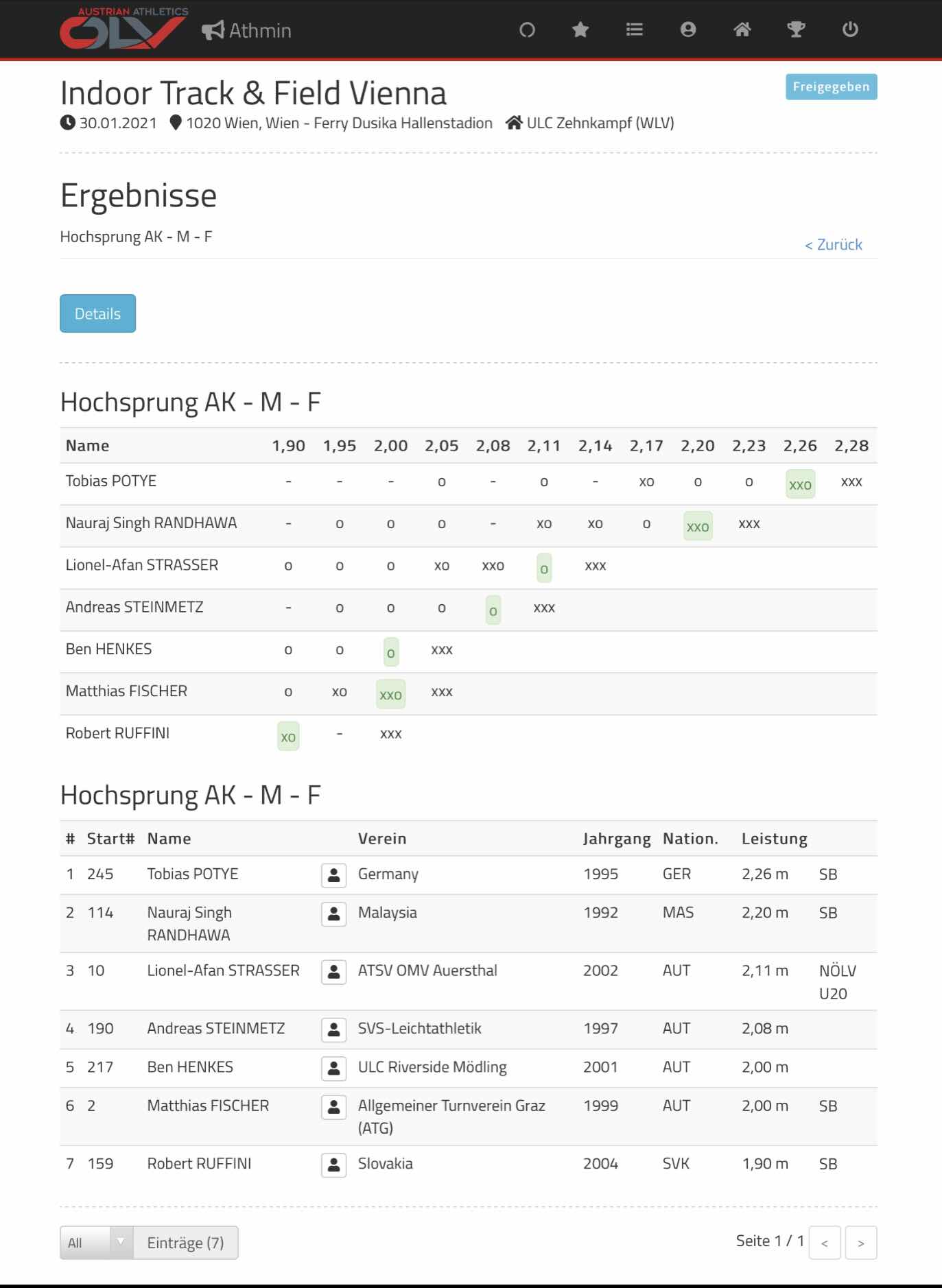
Three-time SEA Games gold medalist Nauraj Singh Randhawa smashed his national indoor record during an indoor track meeting at Vienna, Austria (30 Jan 2021).


He cleared a height of 2.20m in his third attempt  to finish in second place behind German Tobias Potye, a world cup bronze medalist who registered 2.26m.


Nauraj, who turned 29 three days earlier improved his two-year old record by 1 cm, which he set in Chemnitz, Germany in 2019. 


Like other athletes, he was affected by the COVID-19 pandemic and has not competed since the SOPAC meeting in Sydney in February last year, where he jumped 2.20m, the same height he achieved yesterday.


He holds the current national outdoor record of 2.30m from 2016.  


Progression of Malaysian indoor record.


 • 2.15 ..... Lou Cwee Peng ... Toronto ... 1993
 • 2.15 ..... Lee Hup Wei ... Ostrava ... 2012
 • 2.15 ..... Lee Hup We ... Vienna ... 2012
 • 2.19 ..... Nauraj Singh Randhawa ... Chimnetz ... 2019
 • 2.21 ..... Nauraj Singh Randhawa ... Vienna ... 2021

Read more...

Effects of Home Confinement on Training Habits and Injury in Long Distance Runners

>> December 18, 2020

Due to COVID-19 pandemic, policies of social distancing became commonplace in different places or countries. 

Athletes who are typically active and 'busy' (training and competition) were suddenly required to stay at home.

The influences of such restrictions in training habits and injury in youth long-distance runners were unknown.

A recent study by Bazett-Jones and colleagues (link below) found that COVID-19 social distancing restrictions significantly impacted youth long-distance runners' training habits, injuries, and care seeking behaviors. 

Specifically, during the confinement period, youth long-distance runners decreased their training activities (as follows), possibly due to extrinsic factors such as motivation.

  • Weekly running distance
  • Number of weekly runs
  • Number of weekly hard runs 
Interestingly, the number of reported injuries decreased significantly for the group during the COVID-19 quarantine, and cited to be due to decreases in training volume and intensity.

Running habits and injury incidence before and during COVID-19 social distancing restrictions.

Number of self-reported injuries before and during COVID-19 restrictions by location and injury type.

From one perspective, reduced injuries (because of home confinement) is good. However, in a case of you got injured during the quarantine period, it would be more challenging for athletes to receive a proper treatment.

Indeed, the study also reported that the runners, actually reduced their visits to health care providers during quarantine by 3.6 times (i.e. 58.5%  from 16.4% before lockdown), most probably due to movement restrictions, etc. 

The outcomes suggest that "strategic plans to maintain access to medical services" during such event (quarantine) is necessary. 

In summary, the authors highlighted that "COVID-19 pandemic resulted in significant decreases in both training and injuries." 

The authors further clafiried that their findings were different compared to previous reports in an adult population. 

Read more: https://www.ncbi.nlm.nih.gov/pmc/articles/PMC7739837/ 

Read more...

Grace Wong threw 61.62 in hammer, Luqman Hakim leapt 7.85 long jump

>> December 12, 2020

Several good results were achieved by the national athletes today (12 December 2020) during the National Sports Council (NSC) carnival or "competition simulation."

The multi-sports event was participated mostly by athletes living and training within the NSC training ground, with additional invitations for selected athletes.

This event was conducted to provide the national athletes of various sports, a means to experience  "real competition situation" after (mostly) not having the chance to compete for a long time because of the COVID-19 pandemic, under a "real competition situation" (i.e. competition simulation).

However, as informed to all athletes and coaches, none of the performances achieved in the "simulation meet" could be considered as official competition performance.

Day 2 competition will be held tomorrow. Selected results are as follows:

MEN

100m 
Race B (-0.1)

  1. Jonathan Nyepa 10.60
  2. Muhammad Haiqal Hanafi 10.65
  3. Muhammad Azeem Mohd Fahmi 10.94

400m

Race A

  1. Luqmanul Hakim Khairul Akmal 48.71
  2. Abdul Wafiy Roslan 49.32
  3. Muhammad Aftar Rosli 50.76
  4. Mohd Nasharuddin Mohammad 51.09

Race B

  1. Rusleem ZikryPutra 48.83
  2. Muhammad Saiful Safwan Saifuddin 49.78
  3. Muhammad Zulfiqar Ismil 52.82

Long Jump

  1. Luqman Hakim Ramlan 7.85
  2. Andre Anura 7.68
  3. Mohd Latiff Romly 7.50
  4. M Nasir Mustafa 7.43
  5. Saifuddin Ishak 6.58

Hammer Throw

  1. Jackie Wong Siew Cheer 65.68
  2. Sadat Marzuki Ajisan 56.87

WOMEN


100m (+1.0) (i.e. men race A)

  1. (4th) Azreen Nabila Alias 12.24

200m (+0.4)

  1. Azreen Nabila Alias 26.02
  2. Winnie Eng May Xin 26.65
  3. Siti Noor AAishah Mohamad 27.35

Long Jump

  1. Kirthana Ramasamy 5.92
  2. Nurul Ashikin Abas 5.85

Shot Put

  1. Norliyana Kamaruddin 10.90
  2. Nur Siti Balqis Mokhtaruddin 10.65
  3. Winnie Eng May Xin 9.96

Hammer Throw

  1. Grace Wong Xiu Mei 62.61 - No National Record
  2. Nurul Hidayah Lukman 53.49

DAY 2

MEN

Shot Put
  1. Ziyad Zolkefli 16.67
  2. Far Loong Deng 16.39
  3. Kamal Farhan Raihan 15.10
Discus Throw (mixed with women)
  1. Abdul Rahman Lee 47.95
WOMEN

High Jump
  1. Ngu Jia Xin 1.71
  2. Yap Sean Yee 1.68
  3. Norliyana Kamaruddin 1.68
Discus Throw
  1. Quenie Ting kung Ni 46.72
  2. Connie Choo Kang Ni 46.13
Triple Jump
  1. Kirthana Ramasamy 13.06
  2. Nurul Ashikin Abas 13.02
Note - none of these performances are eligible for record and ranking purposes.

Read more...

Andre Anura leaps 7.93m Long Jump at KOM Under Distance Meet 2020 (Complete Results)

>> November 07, 2020

There are some excellent results have been recorded by Malaysian athletes during today's quarantine-based under distance meeting at the national training center at Bukit Jalil, Kuala Lumpur (7 Nov).

This included a massive jump of 7.93m by Andre Anura in the men's long jump, Jackie Wong who thrown the hammer iron ball at 66.88m, and his training partner, Grace Wong who twice "surpassed" her national record of 60.99m with best throw of 62.69 in the women's category.

Next, Paralympic champion Ziyad Zolkefli has thrown a good distance of 17.15m in men's shot put,  but there was a good challenge by youngster Farm Loong Deng in second in 16.84m. SEA Games champion Yap Sean Yee has cleared1.81m in women's high jump, while Queenie Ting threw 47.61m in women's discus, just 30cm away from the national record mark.

Only athletes living within the compound of the training center have been allowed to compete. As a result, the meet was only participated by disabled- and able-bodied national athletes.

Results are as follows:

MEN

60m

  1. Abdul Latif Romly 6.5h
  2. Nixson Kennedy 6.6h
  3. Muhammad Afiq 7.0h
  4. Ahmad Solihim 7.1h
  5. Benedict Ian Gawok 7.2h

300m 

Race A

  1. Luqmanul Hakim Khairul Akmal 33.8h
  2. Wan Muhammad Fazri Wan Zahari 34.4h
  3. Jonathan Nyepa 34.6h
  4. Mohd Haiqal Hanafi 35.5h

Race B

  1. Muhammad Aftar Rosi 35.0h
  2. Mohd Nasharuddin Mohamad 36.1h
  3. Mohamad Faiz 39.8h
  4. Wan Fuzi 40.6h
  5. Jaklon Ganding 41.5h

1000m

  1. Muhammad Haqeem 2:44.7h      *(amended from 2:33.7h)
  2. Ruslem Zikry Putra 2:47.0h
  3. Muhammad Saiful Safwan Saifuddin 2:47.0h
  4. Mohamad Nurdin 2:48.0h
  5. Abdul Wafiy Roslan 2:53.9h

Shot Put

  1. Ziyad Zolkefli 17.15
  2. Farm Loong Deng 16.84
  3. Kamal Farham A.Rahman 15.76

Hammer Throw

  1. Jackie Wong Siew Cheer 66.88
  2. Sadat Marzuqi Ajisan 55.28

Long Jump

  1. Andre Anura 7.93
  2. Luqman Hakim Mohd Ramlan 7.37
  3. Muhmmad Hakimi Ismail 6.91
  4. Zulkifli Abdullah 6.75
  5. Eddy Bernard 6.21
  6. Saifuddin Ishak 6.02
WOMEN

300m

  1. Azreen Nabila Alias 41.5h
  2. Siti Noor Aishah Mohdmad Ariffin 43.4h
  3. Norliyana Kamaruddin 44.1h
  4. Siti Nor Zulaikha 44.6h

High Jump

  1. Yap Sean Yee 1.81
  2. Ngu Jia Xin 1.73

Long Jump

  1. Kirthana Ramasamy 6.03
  2. Nurul Ashikin Abas 5.70
  3. Mahira Hanis Ishak 5.56
  4. Winnie Eng 5.18

Discus Throw

  1. Queenie Ting Kung Ni 47.61
  2. Connie Choo Kang Ni 46.25

Hammer Throw

  1. Grace Wong Siew Mei 62.69 (No NR)

This quarantine-based trials was an alternative "competition" for the national athletes after the last meeting they competed before the Movement Control Order (Malaysian lockdown) on 18 March. The easing of restrictions under a Conditional Movement Control Order (CMCO) started on May 4 for 6 weeks, allowed most businesses to open under strict norms of practice, but not sporting competitions.

The CMCO was implemented again started from the second week of October as the COVID-19 cases rise, causing "actual competitions" cannot be held (at least until the first week of December). 

Several competitions that were scheduled to take place in November, such as Perak open were cancelled.

The national athletics championships is expected to be held in the second week of December, but it is also depend on the future "restrictive measures" by the government.

Note: No national record would be considered in this meet.

Read more...

What are the 4 phases in the 100m?

>> June 18, 2020

The 100-meter sprint is a 10-s race (men), making it hard for most observers to understand the event's sequence from start to finish. Coaches employ different racing strategies. Carl Lewis's coach Tom Tellez utilized 5 phases, but Maurice Greene's coach John Smith adopted 7 phases

The approaches used not only helps in creating an efficient execution of a sprint race and understanding the event better, but also allows for customized coaching strategies tailored to each athlete’s strengths and needs. Here, we can break down the 100m into four phases, based on biomechanical demands and what can be emphasized during the race.

The initial phase (0-10m)
This phase involves explosive and efficient movement from the blocks. The first 10m is very distinct from the other phases; the highest velocity generated is only at ~5 m/s (the next phase would be almost double). The acceleration tends to be highest at the beginning, as athletes need to overcome inertia for rapid forward movement. Thus, optimal block setting, efficient "clearance" (first steps), as well as smooth legs 'pumping' and arms 'swinging' are crucial. 

Technically, athletes need to keep a low center of gravity and lean forward to maximize horizontal force. The initial steps are short, lengthening as speed increases. Feet strike just behind the center of mass for optimal propulsion.

Early acceleration is critical; any delay can compromise the entire performance. Athletes may aim to quickly establish a leading position, and maintain an optimal strategy strategy. Note that when Usain Bolt broke the 100m world record (9.58s) in 2009, he was already leading by the 10m mark.

The drive phase (10-30m)
During this segment, athletes focus on generating substantial momentum by applying maximal force. This phase is similar to shifting a vehicle’s lower gear to maximize torque (high force production). 

Efficiency is important here to conserve energy for subsequent stages (e.g., avoid excessive "pumping" of the arms); the focus is generating momentum by exerting maximal force (within very short period) on the track. See the concept of rate of force development.

The maximal acceleration phase (30 to 50/60/70m)
This phase is where the speed is increasing from >90 to 100% of top velocity (thus, max acceleration). Sometimes, this phase is called "maximal velocity." Top velocity may be reached at later part of this phase, depending on one's ability. 

The critical transition here involves moving from a forward-leaning posture to an upright sprint, which would facilitate peak velocity (maximum speed) to be attained. For this reason, optimal execution is therefore imperative, as well as for sustaining the momentum generated earlier. 

Many top sprinters use this phase to differentiate themselves (ie, at 30-60m) among rivals of comparable early acceleration. 

The maintenance (50/60/70m to finish)
The final stage is characterized by the maintenance of velocity achieved in prior phases. The objective here is not to accelerate further, but to efficiently sustain velocity. 

The ability to decelerate less than competitors during this phase often results in overtaking opponents towards the finish. 

Here, a proper sprinting form is crucial; otherwise, poor technique can affect coordination, influencing stride length and cadence. This may lead to longer ground contact times, which can slow athletes down and reduce their push-off ability.

Final thought ...
Each phase is integral to the race's overall strategy and requires meticulous execution to optimize performance outcomes. 

For optimizing understanding of performance and coaching, it is important to record data (i.e., during competitions) at key intervals: at 10m to evaluate early acceleration, at 30m to assess the drive phase (10-30m splits), at 60m (30-60m) to assess maximal velocity, and from 60 to 100 meters to analyze the maintenances. This approach helps in refining racing and training strategies, and therefore, improve sprint performance.

Read more...

Perak All-Comers 2020 - Full Results

>> February 23, 2020

Ipoh, 22-23 Feb 2020 "Perak All-Comers I 2020"
- best and selected results as follows:


MEN

100m (-2.4) (23)
1. Muhammad Azeem Fahmi 10.88
2. Muhammad Arsyad Md Saat 11.04
3. Abdul Latif Romly 11.05
4. Nabil Alwani Rizal Alwani 11.05

Heats
- heat 1 (-0.9)
1. Muhammad Arsyad Md Saat 10.87

- heat 3 (+0.9)
Muhammad Zahid Roskalana 10.93

- heat 4 (+1.0)
 Nabil Alwani Rizal Alwani 10.92

- heat 15 (-0.4)
Muhammad Azeem Fahmi 10.85

- heat 17 (+1.0)
Abdul Latif Romly 10.84, Ahmad Azizi Rozaini 10.92

200m (+1.1) (22)
1. Muhammad Azeem Fahmi 21.04
- 15 year old, born April 2004

400m (22)
1. Muhammad Ilham Suhaimi 47.71
2. Loganes Thilaganathan 48.17

800m (23)
1. Avinesh Austin Murugan 1:56.04
2. Mohamad Amirul Arif Mohd Azri 1:56.41
3. Wan Muhammad Fazri Wan Zahari 1:56.86

1500m (22)
1. Mohamad Amirul Arif Mohd Azri 4:04.11

3000m Sc (23)
1. Ahmad Luth Hamizan 9:55.37

110mh (+1.1) (22)
1. Rayzam Shah Wan Sofian 14.49

High Jump (22)
1. Mohamad Eizlan Dahalan 2.08
2. Norhafiee Mohd Shah 2.05

Long Jump (22)
1. Luqman Hakim Ramlan 7.69
2. Mohd Nazri Mustaffa 7.37

Triple Jump (23)
1. Andre Anura 15.91

Shot Put (22)
1. Farm Loong Deng 15.50
2. Kong Chin Poh 15.10

Discus Throw (23)
1. Abd Rahman Lee 47.39

Hammer Throw (22)
1. Sadat Marzuqi Ajisan 56.21
- he broke meet's record of 53.92 set by Wong Tee Kui in 1992.
2. Evan Allenby Edmund 45.91
3. Rizad Azri Che Radzi 43.48

Javelin Throw (23)
1. Mohd Alif Mohd Razi 55.47
2. Ng Yong Jie 54.70

10000m Walk (23)
1. Teban Raj Chander 49:44.45
2. Muhammad Fakhrul Razi Jailani 49:48.25
3. Irfan Hanania Abdul Shahir 49:50.51
4. Muhammad Aliff Mubarak Ahmad 49:50.96

4x100m (22)
1. TCB Winners Team (?,?,?,?) 41.45


WOMEN

100m (+1.5) (23)
1. Nurul Wardatul Huwaida Hamka 12.29

400m (22)
1. Chelsea Cassiopea Bopulas 56.48

1500m (22)
1. Padhmaloshini Jayaseelan 4:59.98

5000m (22)
1. Puspa Letchumy Jaintheran 18:50.13

3000m Sc (23)
1. Pavitra Das 12:12.66
2. Ramiyah Balasingam 12:29.19

400mh (23)
1. Nur Nasyatul Nadia Md Nasri 63.60

High Jump (23)
1. Yap Sean Yee 1.76
2. Norliyana Kamaruddin 1.73
3. Ngu Jia Xin 1.70

Long Jump (23)
1. Mahira Hanis Ishak 5.56

Triple Jump (22)
1. Nurul Ashikin Abas 12.80
2. Mahira Hanis Ishak 12.38

Shot Put  (23)
1. Nani Sahirah Maryata 12.64

Hammer Throw (23)
1. Nurul Hidayah Lukman 49.91
2. Nur Fazira Jalaluddin 45.32
3. Nur Aqilah Abdul Hakim 42.46

Javelin Throw (23)
1. Nur Ayna Nuha Maton 41.31
 - she broke the meet's record of 41.00 set by Lee Boon Bee in 1996.

5000m walk (22)
1. Nurul Alyahaziqah Kamaruzaman 27:15.16


Perak All-Comers I 2020 - FULL RESULTS

Read more...

Azeem Fahmi sets 200m PB at 21.04 (+1.1) Perak All-Comers 2020

>> February 22, 2020

Malaysian sprint sensation Muhammad Azeem Fahmi had an impressive season opener by setting a new personal best in the 200m during the 1st day of Perak All-Comers at Ipoh today (22 Feb 2020).

The 15-year-old clocked a time of 21.04 (+1.1), erasing his previous best of 21.15 he set last year in Thailand. Read here

He was not pushed to his maximum and crossed the line ahead of his closest opponent by at least 10 meters.

This shows that he will run even faster in the 200m and will likely improve on his 100m best time of 10.57, which he set in November last year. Read here

In Malaysia, only six senior sprinters have run faster than him, with Russel Taib's national record of 20.77 leading the list.

This is followed by Khairul Hafiz Jantan at 20.90 that broke the Malaysian long-time record in 2017. Behind him is the time of 20.92 shared by M. Jegathesan from 1968 and Jonathan Nyepa from 2019.

Azmi Ibrahim ran 20.97 nineteen years ago, and Aqil Yasmin's 21.01 set on the same track today, was another one above Azeem's.

Day 1 full results can be downloaded here.


Read more...

ASIAN LEADERS (Men)

To be updated

STATISTICS

STATISTICS

ASIAN LEADERS (Women)

To be updated

Statistics


ARCHIVES

Copyright © 2009-2018, AdrianSprints.com . All Rights Reserved . Policy . Term of Use
Sports Top Blogs Sports blogs & blog posts Free Web Stats

Back to TOP